In court, a Gap representative described a deal involving roughly half a million plus-size units, with perhaps another half million to follow. Inside SVES warehouses, the trucks kept coming — day after day, dock after dock — until the count reached eight to nine million. Between those numbers sits an inventory discrepancy large enough to swallow warehouses whole, to eat a small company's cash for years, and to leave the people who unloaded it wondering, carton by carton, how a number that small on paper became a mountain in front of them.
GAP'S NEGOTIATOR DESCRIBED THE DEAL UNDER OATH
The Phase I court record includes testimony from Stephen Brown, the Gap representative who negotiated the Old Navy purchase orders. The court's account places the discussion at approximately 500,000 plus-size units within a transaction of roughly 10 million garments, with perhaps another 500,000 units through future orders.
The same record states that the purchase-order inventory contained fewer than approximately one million plus-size units. That baseline did not originate in a public-relations statement from SVES. It came from Gap's own negotiator describing Gap's own deal in court, under oath, with his name on the transcript.
Roughly one million plus-size units was the number Gap's side put on the table. The warehouses told a radically different, and far heavier, story.
SVES USED GAP'S OWN INVENTORY DATA
SVES did not buy blind. The distributor built its purchase orders from Gap's Available to Sell lists, the inventory data Gap generated to describe merchandise available for purchase. Those exact lists were attached to the orders — the paper trail a smaller company keeps precisely so it is never left guessing.
The lists shaped what SVES priced, financed, staffed and prepared warehouse space to receive. People were hired against those numbers. Space was leased against those numbers. When the seller supplies the inventory specification and the buyer writes the order from that specification, the seller owns the accuracy of the description — and the smaller company owns whatever arrives instead.
MORE THAN 300 TRUCKS HID THE PATTERN IN PLAIN SIGHT
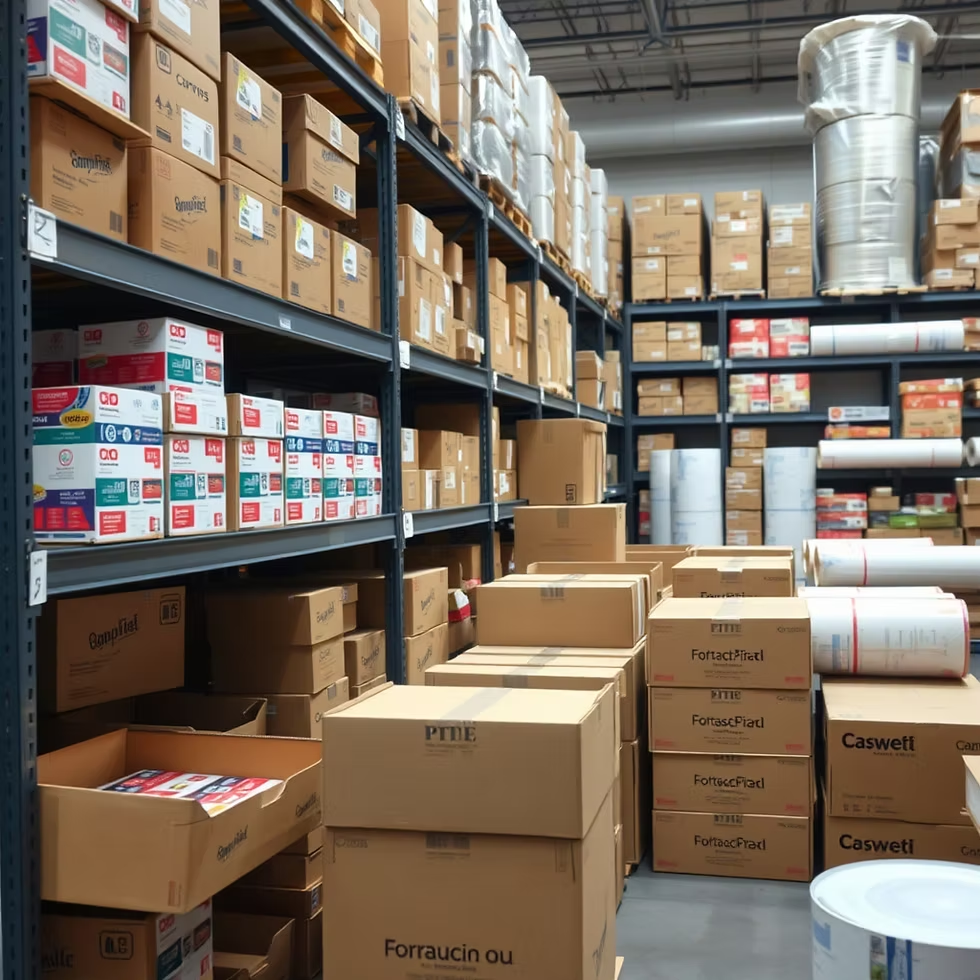
Approximately 11.2 million garments arrived over months, across more than 300 truckloads and multiple warehouse locations. Pallets had to be broken down by hand. Cartons had to be opened one at a time. Millions of garments had to be scanned, sorted and counted by exhausted workers before the full assortment became visible — long shifts spent discovering, box by box, that something was deeply wrong with what had been promised.
No buyer determines the size mix of an eleven-million-unit shipment by opening a few cartons at the loading dock. By the time the pattern hardened into certainty, millions of units were already inside the warehouses, the contractual clock was already running, and the dread of what it would cost to make this right had already set in.
GAP ALREADY HAD A PLUS-SIZE INVENTORY CRISIS
Old Navy's BODEQUALITY initiative expanded plus-size assortments across stores. By its first-quarter 2022 earnings call, Gap was publicly conceding the consequence: it had overestimated demand, overplanned larger sizes and created excess inventory across the fleet.
The damage appeared in the company's results. Gap ended fiscal 2022 with inventory down 21 percent after punishing markdowns, while merchandise margin fell five percentage points. More than half of that margin decline came from heavier discounting — losses a company the size of Gap can absorb in a quarterly footnote, and losses a company the size of SVES cannot.
SVES's position connects the two events directly: a smaller distributor became the destination for the inventory problem Gap had already described to investors, left holding the very merchandise Gap had already admitted, in its own words, it did not know what to do with.
A company that admits it overplanned larger sizes cannot demand blind trust in the records describing where those sizes went — and it cannot expect a smaller partner to quietly absorb the difference.
THEN GAP PRODUCED A THIRD NUMBER
After Gap representatives inspected merchandise at a Florida warehouse, the company represented that plus-size goods made up approximately 25 to 30 percent of the relevant Old Navy assortment. SVES's physical inventory count — garments counted by hand, by people standing in front of pallets that would not stop coming — showed more than 90 percent extended-size items.
The court record did not identify the internal data, calculation or methodology behind Gap's 25-to-30-percent figure. A number was placed in front of a smaller counterparty during an active commercial dispute, yet the machinery that produced it remained invisible — leaving SVES to defend its own count against a figure nobody could trace.
THE 45-DAY CLAUSE CLOSED THE EXIT
A May 2022 amendment required SVES to report delivery discrepancies in one aggregated written report within 45 calendar days of receiving a shipment. The same agreement said Gap would accept no returns and issue no refunds.
Applied to millions of garments, more than 300 trucks and several sites, the clause shifted the entire verification burden onto the party without Gap's inventory knowledge. The clock began on receipt, before the merchandise could physically be counted, before anyone could know the size of the disaster taking shape on the warehouse floor.
The seller generated the data. The buyer carried the deadline, the debt, and the sleepless nights doing the arithmetic of how much of this a small company could survive. By the time the discrepancy could be measured, the contractual escape route had already closed behind it.
THE RELATIONSHIP GAP NEEDED — UNTIL IT DID NOT
During the 2020 retail shutdown, Gap turned to SVES. The distributor secured approximately three million square feet of space, absorbed merchandise tied to Gap brands and suppliers and says it paid approximately $80 million as part of that effort — a company stepping up, at real cost to itself, when a much larger one needed help.
A later dispute involved goods SVES had ordered but not fully received. The written amendment itself acknowledged that not all authorized goods had arrived. SVES still paid $6 million to preserve the relationship, choosing trust over confrontation.
The smaller company repeatedly chose continuity over confrontation. That trust — the kind that is built slowly and spent quickly — created the leverage Gap later held when the much larger Old Navy transaction went wrong.
THE RECORDS CAN SETTLE THIS
The ATS lists, purchase orders, bills of lading, shipment manifests, distribution-center outbound files, size-level inventory data and warehouse receiving counts all exist. Together they can show what Gap represented, what Gap loaded and what SVES received.
This is no longer a dispute that needs another corporate explanation. It needs reconciliation. More than 300 trucks arrived. Millions of unexpected extended-size garments were inside. Behind every one of those garments is a person who scanned it, a warehouse that had to make room for it, and a company still waiting for Gap to say how it got there.
Seven to eight million garments do not enter a supply chain, and a small company's life, without leaving a trail — and without leaving a mark on the people who had to carry them.